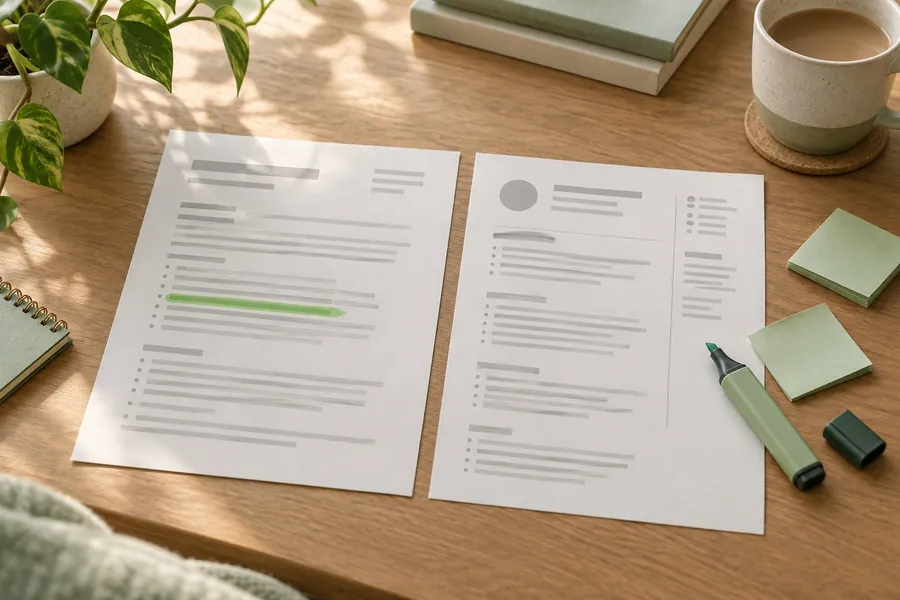
A CV can be accurate and still make your experience hard to understand. The problem is often a collection of small choices: a missing contact detail, a vague opening, an important achievement buried under routine duties. Fixing these choices is more useful than looking for a secret phrase that guarantees interviews. Start with the reader's task. They need to understand your background, find evidence that matches the opening and know how to contact you. Your document should help them do that without guessing.
Mistake 1: Sending the same emphasis everywhere
You do not need to rewrite your life for every application. You do need to change which parts of it are easiest to see. Imagine a receptionist applying for an office coordinator role. Her original CV leads with greeting visitors and answering calls. The new job also asks for supplier communication and meeting arrangements. If she has done those tasks, they deserve earlier bullets. The facts stay the same; their order changes. Read the advertisement, identify its important requirements and check whether your CV answers them with actual examples rather than broad promises.
Mistake 2: Describing qualities without evidence
"Reliable, motivated team player" gives a reader little to evaluate. Replace it with an action that demonstrates the quality. A fictional warehouse assistant could write: "Completed opening stock checks and recorded discrepancies before the morning dispatch team arrived." That sentence shows a useful responsibility without inventing a dramatic result. If you know the outcome, add it. If you cannot verify a percentage or saving, leave it out. Harvard's careers guidance recommends specific, active, fact-based language. Your goal is clarity, not a louder claim than the evidence supports.
Mistake 3: Treating duties as achievements
Some duties need explaining, especially when a job title is unfamiliar. But a CV made entirely of "responsible for" statements leaves your contribution unclear. Ask what you handled, what changed or what depended on your work. "Responsible for invoices" might become "Checked supplier invoices against purchase orders and flagged mismatches for the finance officer." You have not claimed that you transformed the business. You have shown the work. Where genuine results are available, distinguish your role from the team's. "Supported" is better than "led" when someone else owned the project.
Mistake 4: Hiding useful experience
Paid employment is not the only source of evidence. The UK National Careers Service includes placements, volunteering and projects in its guidance. An applicant for a junior events role might have arranged a student society venue, maintained a guest list and coordinated volunteers. Those activities belong in a clearly labelled section, not in a tiny hobbies line. Do not rename an unpaid activity as paid employment. Give the organisation or project, your real role, dates and useful actions. Honest labels help the employer understand both the experience and its limits.
Mistake 5: Adding private information by habit
A template may contain fields you do not need. Do not fill them simply because they exist. Canada's Job Bank advises against unnecessary personal information and photographs for Canadian resumes. UK guidance also recommends leaving out age, date of birth, marital status and nationality. Other markets have different customs, so check the destination rather than treating one country's practice as universal. Avoid identity numbers, bank information or someone else's reference details in a general CV. If an application asks for sensitive information, check the legitimacy and purpose of that request separately.
Mistake 6: Making the layout do too much
A decorative layout can hide the information it is meant to organise. Start with readable headings, consistent dates and enough space between sections. Test whether the name, recent role and key evidence are easy to locate. Avoid making the font smaller just to preserve an unnecessary paragraph. Where an online application is involved, a simple text-based layout also reduces avoidable parsing risks. That does not mean every visual CV fails. It means the design should serve the application process, not compete with your qualifications for attention.
Mistake 7: Proofreading only the sentences
Spelling checks cannot catch every factual error. Review the email address, phone number, employer names, qualification titles and dates independently. Open portfolio links and check they show the intended work. Compare dates against your own records rather than trusting an old draft. Then read for language. If possible, ask another person to look for unclear wording and inconsistent formatting. Canada's Job Bank and Harvard both stress proofreading. A useful review asks "What would confuse a stranger?" as well as "Is this spelled correctly?"
Mistake 8: Trusting the export without opening it
Your editable version is not necessarily the document an employer receives. Export the file, open that exact copy and inspect every page. Check that a heading has not been stranded at the bottom, bullets have not moved and links still work. For a text-based PDF, try selecting and copying a paragraph. This is a basic check, not a guarantee of compatibility with every recruitment system. Follow the employer's requested file type and naming instructions. Use a clear filename that distinguishes the final application from your working drafts.
A practical final edit
Make one pass for relevance, one for accuracy and one for presentation. During the relevance pass, remove material that repeats stronger evidence. During the accuracy pass, check every number and description you might be asked to explain. During the presentation pass, review the exported file rather than the editor alone. Keep a copy of the advertisement and submitted CV together. If an interview follows, you will know exactly what the employer saw. A careful CV cannot promise an offer, but it can stop avoidable mistakes from obscuring what you can do.
Sources and scope
Original general guidance informed by careers resources. Reviewed 10 October 2026. Employer instructions and local expectations take priority. No interview, hiring or ATS result is guaranteed.
Put it into practice.
Write a first draft in your own words, then review it carefully.
Start your CV ↗